Canon RF lenses: the practical buying guide
The short version: everyone with an EOS R camera should own the RF 50mm f/1.8 STM. After that, choose between a stabilized budget zoom and an f/2.8 zoom — and don’t overlook adapted EF lenses.
Last updated November 2, 2026Canon’s RF mount launched in 2018 and now covers everything from the beginner R100 and R50 to the professional R1 and R5 Mark II. Unlike Sony, Canon has kept tight control over who makes autofocus lenses for RF, so the lens choice is more first-party — with a large, affordable back catalog of EF DSLR lenses that adapt with no loss. This guide explains which RF lenses are worth buying, how RF and RF-S mix, and when adapting makes more sense than buying new.
Canon RF bodies, briefly
All EOS R mirrorless cameras share the RF mount. The difference that matters for lenses is sensor size: full frame (R8, R6 Mark II, R5 Mark II, RP and others) or APS-C (R50, R10, R7, R100).
| Body | Sensor | Best for | Price |
|---|---|---|---|
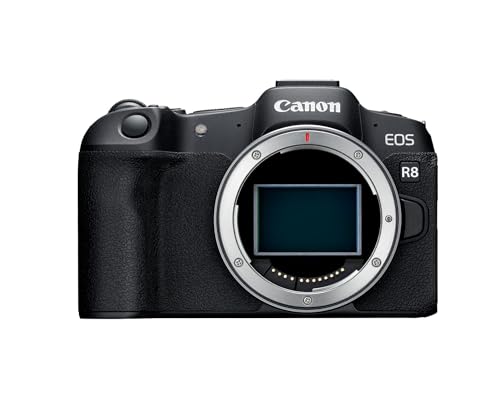
| Canon EOS R8 On our deal list | Full frame · 24MP | Lightest full-frame RF body; R6 II-class sensor and AF | List ~$1,499; on our drops list |
| Canon EOS R6 Mark II | Full frame · 24MP | IBIS, dual card slots, bigger battery — the enthusiast workhorse | Search Amazon |
| Canon EOS R5 Mark II | Full frame · 45MP | High-resolution stills and 8K video | Search Amazon |
| Canon EOS RP | Full frame · 26MP | Older entry full frame; cheapest way in if you find one new | Search Amazon (check new vs renewed) |
| Canon EOS R7 | APS-C · 32.5MP | Wildlife and sports reach with IBIS and fast bursts | Search Amazon |
| Canon EOS R10 | APS-C · 24MP | Enthusiast APS-C with an EVF and joystick | Search Amazon |
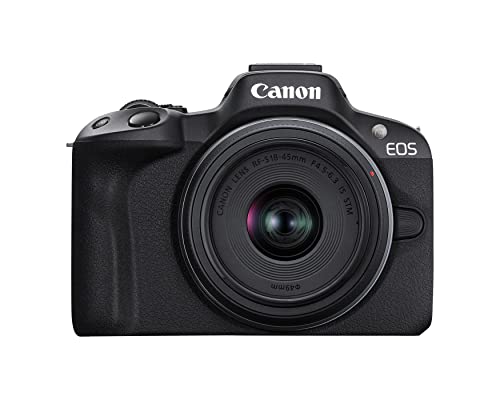
| Canon EOS R50 On our deal list | APS-C · 24MP | Small, simple, strong autofocus — the best beginner RF body | On our deal list |
Two quirks to know: the R8, R50, R10 and R100 have no in-body stabilization, so Canon’s “IS” lenses help more on them; and the R8 and R50 use small batteries, so a spare is a sensible add-on to any deal.
Full frame (RF) vs APS-C (RF-S)
- RF lens on an APS-C body: fully compatible; the field of view is cropped by 1.6×. A 50mm frames like an 80mm.
- RF-S lens on a full-frame body: mounts and works, but the camera switches to crop mode — about 9.5MP on the 24MP R8.
- Which to buy: if you might upgrade to full frame, favor RF lenses. If you’re staying on an R50 or R10, RF-S lenses and Sigma’s APS-C primes are smaller and cheaper.
| Lens | On full frame | On APS-C (1.6×) |
|---|---|---|
| Canon RF 50mm f/1.8 STM | 50mm | ≈ 80mm |
| Canon RF 16mm f/2.8 STM | 16mm | ≈ 26mm |
| Canon RF 24-105mm f/4-7.1 | 24-105mm | ≈ 38-168mm |
| Sigma 18-50mm f/2.8 (RF-S) | Crop mode only | ≈ 29-80mm |
| Canon RF-S 18-150mm | Crop mode only | ≈ 29-240mm |
Best Canon RF lenses by focal length
Value picks first. Items marked “On our deal list” link to products we track on our Canon RF deals page; others open an Amazon search for current listings.
| Focal length / use | Full-frame (RF) pick | APS-C (RF-S) pick | Notes |
|---|---|---|---|
| Ultra-wide | Canon RF 16mm f/2.8 STM | Canon RF-S 10-18mm f/4.5-6.3 IS STM | Sigma’s 10-18mm f/2.8 DC DN for RF is the brighter APS-C option |
| Standard zoom (budget) | Canon RF 24-105mm f/4-7.1 IS STM | Canon RF-S 18-150mm IS STM | Common kit lenses; often cheapest bought in a body bundle |
| Standard zoom (fast) | Canon RF 28-70mm f/2.8 IS STM | Sigma 18-50mm f/2.8 DC DN (RF) | Sigma’s RF version is the same optics as the Sony E lens on our list |
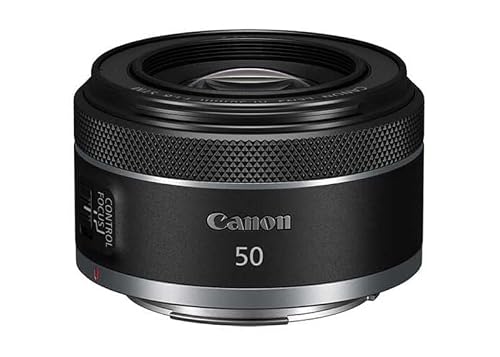
| Normal prime (50mm) | Canon RF 50mm f/1.8 STM On our deal list | Sigma 30mm f/1.4 DC DN (RF) | RF 50mm on APS-C ≈ 80mm — a great cheap portrait lens on the R50 |
| Wide prime / macro | Canon RF 35mm f/1.8 Macro IS STM | Sigma 16mm f/1.4 DC DN (RF) | The RF 35mm adds stabilization and 0.5× macro |
| Portrait (85mm) | Canon RF 85mm f/2 Macro IS STM | Sigma 56mm f/1.4 DC DN (RF) | Sigma 56mm on APS-C ≈ 90mm equivalent |
| Telephoto / wildlife | Canon RF 100-400mm f/5.6-8 IS USM | Canon RF-S 55-210mm IS STM | RF 100-400mm on an R7 or R50 ≈ 160-640mm equivalent |
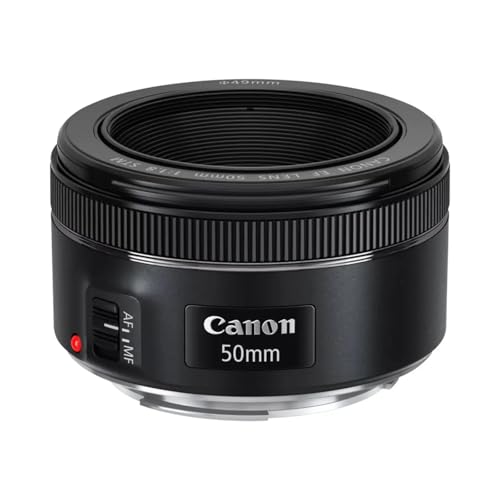
| Adapted DSLR fifty | Canon EF 50mm f/1.8 STM + EF-EOS R adapter On our deal list | Same | Only worth it if you already own the EF lens or adapter |
The RF 50mm f/1.8 STM is the easiest recommendation in the system
It weighs about 160 g, focuses as close as 30 cm, and is sharp enough stopped down to f/2.8 to rival far more expensive lenses. Its STM motor is a little noisy for on-camera audio, but for stills it’s hard to beat. Details on our RF 50mm f/1.8 page.
Budget zoom or f/2.8 zoom?
The RF 24-105mm f/4-7.1 IS STM is light, stabilized and cheap, especially in an R8 kit — but its f/7.1 long end struggles indoors. The RF 28-70mm f/2.8 IS STM (2024) is the first affordable constant-f/2.8 Canon standard zoom and the better choice for indoor events and low light. On APS-C, Sigma’s 18-50mm f/2.8 fills the same role.
Third-party lenses on Canon RF
- Licensed APS-C autofocus: since 2024, Sigma and Tamron make officially supported RF-mount APS-C lenses — Sigma’s 18-50mm f/2.8, 10-18mm f/2.8 and 16/23/30/56mm f/1.4 primes; Tamron’s 18-300mm and 11-20mm f/2.8. These are the best value lenses for the R50, R10 and R7.
- Full-frame autofocus: options are still limited compared with Sony E. Some unlicensed AF lenses have been released and later withdrawn, so check that a lens is officially supported and still sold before buying.
- Manual focus: Samyang, Laowa, TTArtisan, 7Artisans and others sell manual RF primes; good for video and creative work.
Adapting EF and EF-S lenses
Canon’s own Mount Adapter EF-EOS R is the reason many photographers moved to RF painlessly. There are three versions: the basic adapter, a control-ring version that adds a customizable ring, and a drop-in filter version that takes a variable ND or circular polarizer — useful for video and for ultra-wide lenses that don’t take front filters.
- EF lenses autofocus as well as or better than on DSLRs, with full stabilization and lens corrections.
- EF-S lenses work too; full-frame bodies automatically crop.
- Used EF L lenses (70-200mm f/4L, 100mm f/2.8L Macro, 17-40mm f/4L) are some of the best values in photography when adapted.
- Our tracked EF 50mm f/1.8 STM (current price) is a fine lens, but if you’re buying new for an RF body, the RF 50mm costs about the same and needs no adapter.
What’s a good price on a Canon RF lens?
- Canon lenses mostly sell at list until a Canon instant rebate. 10–20% off list on first-party glass is a strong price; see our drops methodology.
- Kit lenses are almost always cheaper in a body bundle than bought alone.
- US Canon warranty requires an authorized dealer — skip grey-market or “international version” listings unless the saving is large.
- During November, check our Black Friday lens deals page for current picks.